The anti-Christian myth of First Amendment 'neutrality'
Last week was a hard one for the atheists. President Trump read from the Bible in the Oval Office, and a federal court upheld the right of Texas to display the Ten Commandments. You can just hear the weeping and gnashing of teeth.
A recent legal challenge, one of many in a long line of church-state disputes, raises a now-familiar question: Can the government display the Ten Commandments without violating the First Amendment?
If government exists to protect what is of highest value, then it cannot remain agnostic about the source of those values.
Predictably, the answer from modern critics comes quickly. We have lived under an ACLU regime for 50 years, which has gaslighted us into believing any such display is wrong and illegal. The atheist insists that any public reference to the Bible is unconstitutional. The pluralist adds that if one religious text is displayed, then all must be.
Together, they present what appears to be a dilemma: Either scrub public life of all religious content, or open the floodgates to every creed imaginable.
Both claims, however, rest on a fundamental misunderstanding of the American founding.
To see why, we need to begin with the principles that shaped the United States itself. These are the principles articulated most famously in the Declaration of Independence.
The Declaration does not speak in the language of neutrality. It speaks of “the Laws of Nature and of Nature’s God.” It grounds human equality in the fact that we are “created” and “endowed by [our] Creator with certain unalienable Rights.”
These are not neutral or secular claims. They are claims rooted in what philosophers have long called natural theology: the idea that reason and creation reveal truths about God.
The First Amendment must be read in light of these founding principles, not in isolation from them.
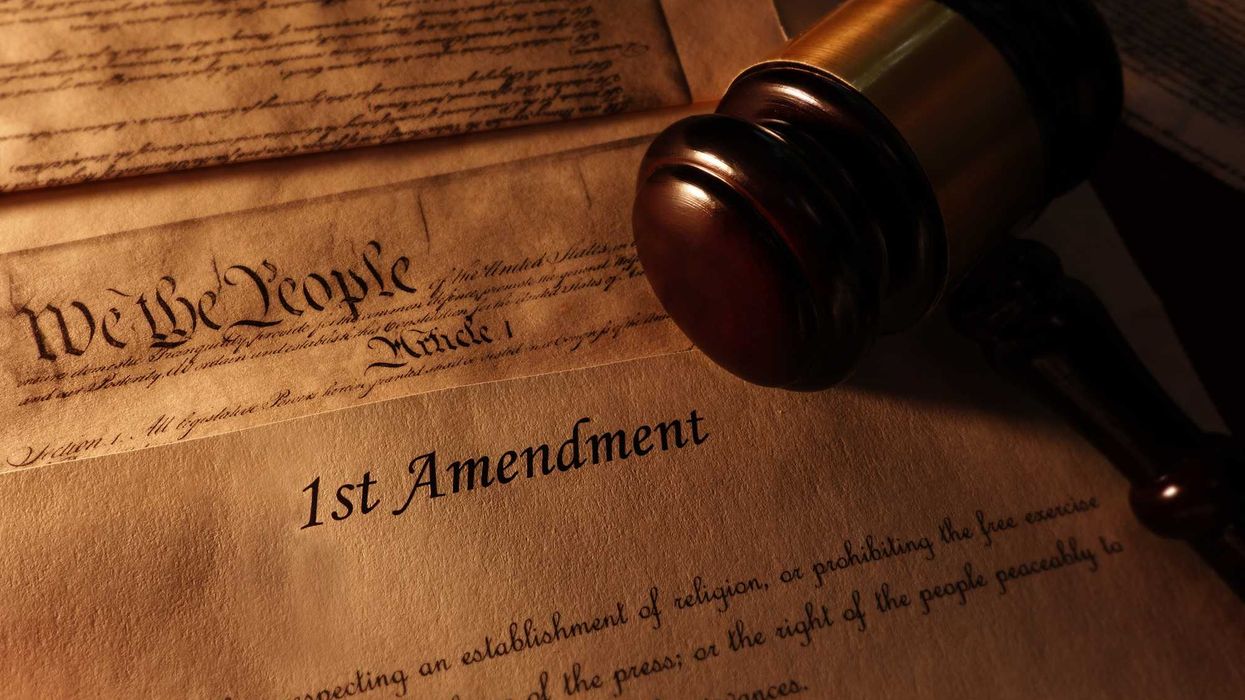
The text itself is straightforward: “Congress shall make no law respecting an establishment of religion, or prohibiting the free exercise thereof.” Notice what it does not say. It does not say that the government must be silent about God.
It does not say that public institutions must pretend religion played no role in the nation’s founding. And it certainly does not say that acknowledging moral truths found in Scripture is forbidden.
What it prohibits is the establishment of a national church and the interference with religious worship.
This distinction is crucial. The founders were not secularists in the modern sense. Many of them (though differing in theological detail) shared a conviction that moral law is grounded in God. That conviction did not lead them to impose a church on the people, but neither did it lead them to erase God from public life.
That is where the Ten Commandments come in.
For centuries, the Ten Commandments have been understood not merely as a religious text, but as a concise summary of the moral law. Prohibitions against idolatry, murder, theft, perjury, and covetousness form the backbone of legal systems throughout the Western world. Even those who reject their divine origin often recognize their ethical clarity.
But here is an often-overlooked point: When the Ten Commandments are displayed, they are displayed as a whole.
This matters because critics frequently attempt to reduce them to commandments five through 10. We can call this the “horizontal” commands governing human relationships. But the full Decalogue begins with the “vertical” commands: to worship God alone, to reject idols, and to honor His name and His day.
To display all 10 is to acknowledge that law is not merely a human construct. It reflects an order that begins with God and extends to human society. That idea is foundational to American law.
This fact is why the atheist objection fails. The claim that the First Amendment requires strict secularism reads modern assumptions back into an 18th-century document. The founders did not believe that public acknowledgment of God violated liberty. On the contrary, they believed liberty depended on it.
Without a grounding in something higher than human will, rights become negotiable and law becomes an instrument of power rather than justice. The very idea of equality (so central to the American experiment) loses its foundation.
The pluralist objection fares no better. It assumes that fairness requires equal representation of all religious claims in public displays. But the United States was not founded on a principle of religious equivalence. It was founded on a particular understanding of God, law, and human nature. This was an understanding shaped by Christianity.
RELATED: Why do state schools bankroll people who despise the state?
 ROBYN BECK/AFP/Getty Images
The Christian nature of American law does not mean that citizens of other faiths are excluded. The First Amendment ensures they are free to worship without government interference. But freedom of worship is not the same as a requirement that the state treat all religious claims as equally foundational to its own identity.
A courthouse displaying the Ten Commandments is not making a claim about every religion. It is recognizing the historical and philosophical roots of its own legal system.
And this brings us back to the central issue: What is the role of government?
If government exists to protect what is of highest value, then it cannot remain agnostic about the source of those values. The founders were clear: These rights come from God. To acknowledge that is not to establish a church; it is to affirm the very basis of the nation’s laws.
Displaying the Ten Commandments alongside the Declaration of Independence is not a constitutional violation. It is a historically informed reminder of where our ideas of law and equality come from.
It tells the truth about the American founding.
In an age increasingly confused about the source of its own principles, telling that truth and teaching it to the next generation is the right thing to do.