I joined a cult — and I'm not leaving
A few years ago, I went all in on CrossFit.
Not casually. Not “a couple of sessions a week.” I mean fully immersed. Dawn classes. Protein evangelism. Callused palms held up like merit badges. A vocabulary that slowly became unintelligible to my friends and family.
Effort has been engineered out of daily existence. The result isn’t ease but restlessness. So people voluntarily buy pain.
It worked, too. I got strong. Very strong. But eventually, the thing that had promised discipline started to feel devotional. The workouts were brutal, yes, but the culture grew insistent — about identity, about belonging, about the strange idea that redemption could be loaded onto a barbell.
I left CrossFit because it started to feel like a cult. Manson family vibes, minus the desert and the murders. It had a creed, but a shallow one: Pain conferred status, while rest felt vaguely shameful. And like most people who escape one intense, borderline insane tribe, I did the most predictable thing imaginable. I joined another.
Enter Hyrox.
20 miserable meters
If CrossFit thrives on variety, Hyrox runs on ritual. The same test. Every time. Everywhere. Eight one-kilometer runs, each broken by a workout station designed to sap dignity and drain glycogen in equal measure.
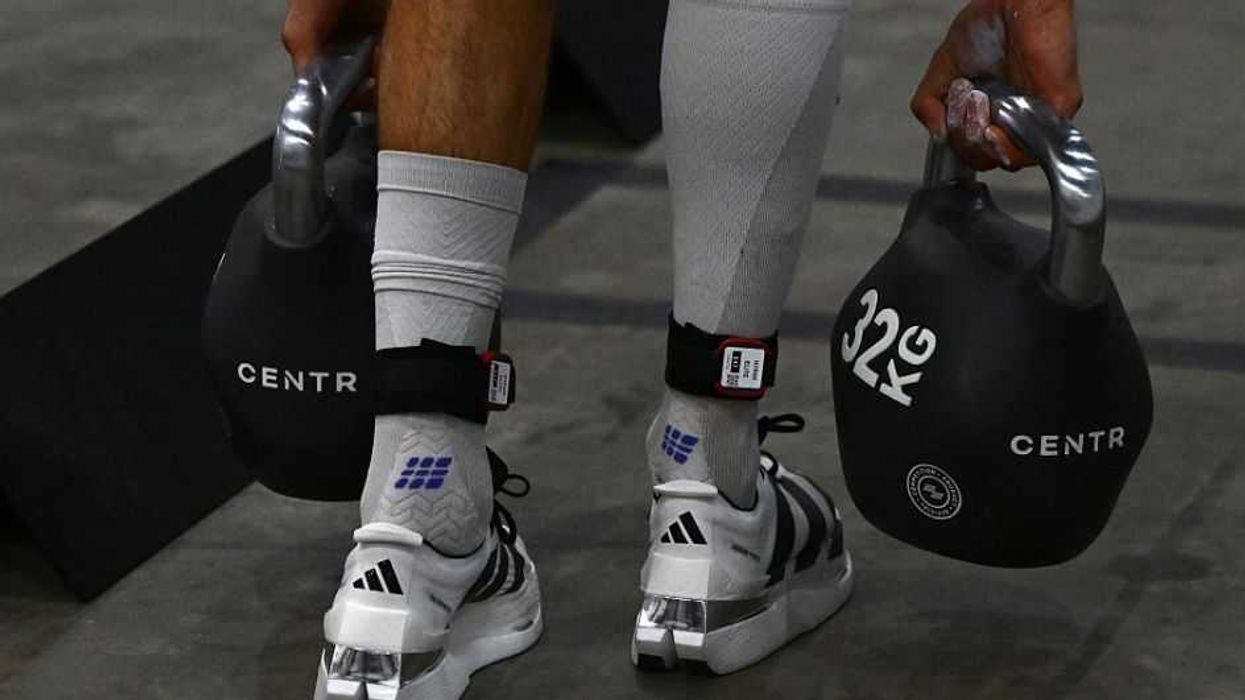
Sled pushes that turn legs to jelly. Burpee broad jumps that make grown adults negotiate with God. Farmer’s carries that compress your entire life into 20 miserable meters. Lunges, rowing, wall balls, the works. No mystery. No surprises. No excuses. You know exactly what’s coming. Which somehow makes it worse.
What began as a handful of lunatics in a warehouse now stretches from Boston to Brisbane. Americans, in particular, go absolutely gaga for this brand of glorified self-flogging. Last year, some 70,000 Americans lined up to compete in Hyrox races.
It’s measurable. It’s standardized. It has timing chips, age brackets, and leaderboards that humiliate you with forensic precision. And as a fully indoctrinated Hyroxer, I can’t pretend I’m above it. I get it.
Something primal
I’ve raced in the U.K., Ireland, and Thailand. Thailand, in particular, feels surreal. You’re preparing for an event designed to dismantle your nervous system while palm trees nod approvingly, someone hawks knockoff iPhones nearby, and ladyboys shout suggestive comments. And yet amid the madness, something primal asserts itself. Suffering, it turns out, is a universal language.
Hyrox isn’t “for everyone,” and it shouldn’t be sold that way. There’s a strange modern habit of presenting extreme physical challenges as all-purpose answers. As if every personal demon can be exorcised with sprints. For some people, this stuff is genuinely stabilizing. Structure helps. Training gives shape to days that might otherwise dissolve. Discipline can be a lifeline.
For others, though, it’s avoidance, plain and simple. I’ve met men and women who, without an outlet this intense, would almost certainly be annoying their lawyers or alarming psychiatrists. Not everything can be lifted, lunged, or rowed into submission. Eventually the joints revolt and the scoreboard stops flattering you.
Comfortably numb
The global popularity tells us something slightly uncomfortable about the moment we’re living in. Modern life is comfortable to the point of numbness. Effort has been engineered out of daily existence. The result isn’t ease but restlessness. So people voluntarily buy pain. They pay for race entries, overpriced shoes, and punishing workouts simply to feel alive again. Hyrox doesn’t negotiate. You run, or you don’t. You move the sled, or it doesn’t move. The feedback is immediate and unforgiving.
And it’s precisely that simplicity that has prompted the next, inevitable escalation: Olympic ambition.
Hyrox’s new Science Advisory Council, a small army of researchers from New Zealand, the U.K., and Europe, signals a sport that wants legitimacy. Standardization, data, physiology, performance analysis — the entire scientific kitchen sink has been thrown at the 2032 dream. On paper, it makes sense. The format is fixed. The judging is clean. The variables are controlled. If breakdancing can make it into the Olympic ecosystem, why not a race that looks like a PE teacher’s revenge fantasy?
Why not, indeed.
RELATED: Women can crush pull-ups too: 5 steps to doing your first
 Wundervisuals/Getty Images
Going mainstream
The Olympics have always been a little ridiculous. They celebrate niche obsessions elevated to national honor. People dedicate their lives to throwing things, jumping over things, sliding on ice in improbable positions. Hyrox fits right in. It’s absurd, yes, but so is speed-walking. So is synchronized swimming. Absurdity has never been a barrier to inclusion.
The more interesting question isn’t whether Hyrox deserves Olympic status. It’s what happens to a cult when it goes mainstream, when something built in warehouses and back alleys gets handed a global spotlight. Like an underground punk band suddenly piped through stadium speakers, intensity changes when scale takes over. What once thrived on proximity starts to lose its edge.
Whatever happens, I’ll line up again. Dublin. Bangkok. London. I’ve drunk the Kool-Aid, I know what’s in it, and I’m still reaching for another cup. There’s no exit interview. No recovery program. I’m not a philosopher. I just know that in a world drowning in opinions and moral lectures, it’s a relief to face a problem that can only be solved by putting one foot in front of the other, until you can’t.